Sorry, you need to enable JavaScript to visit this website.

Alleviating Hallucinations via Supportive Window Indexing in Abstractive Summarization
Error message

  • The specified file temporary://fileq605E3 could not be copied, because the destination directory is not properly configured. This may be caused by a problem with file or directory permissions. More information is available in the system log.
  • The specified file temporary://fileANe3Ee could not be copied, because the destination directory is not properly configured. This may be caused by a problem with file or directory permissions. More information is available in the system log.
  • The specified file temporary://fileXyVXEt could not be copied, because the destination directory is not properly configured. This may be caused by a problem with file or directory permissions. More information is available in the system log.
  • The specified file temporary://fileA8jmZX could not be copied, because the destination directory is not properly configured. This may be caused by a problem with file or directory permissions. More information is available in the system log.
  • The specified file temporary://filerQ0FKA could not be copied, because the destination directory is not properly configured. This may be caused by a problem with file or directory permissions. More information is available in the system log.
  • The specified file temporary://fileGmvbKl could not be copied, because the destination directory is not properly configured. This may be caused by a problem with file or directory permissions. More information is available in the system log.
  • The specified file temporary://fileaNJXbX could not be copied, because the destination directory is not properly configured. This may be caused by a problem with file or directory permissions. More information is available in the system log.
  • The specified file temporary://fileTqkcoJ could not be copied, because the destination directory is not properly configured. This may be caused by a problem with file or directory permissions. More information is available in the system log.
  • The specified file temporary://filey5SB88 could not be copied, because the destination directory is not properly configured. This may be caused by a problem with file or directory permissions. More information is available in the system log.
DOI:
10.60864/09fz-9s23
Citation Author(s):
Jiaxin Duan, Fengyu Lu, Junfei Liu
Submitted by:
Jiaxin Duan
Last updated:
6 June 2024 - 10:54am
Document Type:
Presentation Slides
Document Year:
2024
Event:
Presenters:
Jiaxin Duan
Paper Code:
5296
Categories:
Keywords:
 

Abstractive summarization models learned with maximum likelihood estimation (MLE) have been proven to produce hallucinatory content, which heavily limits their real-world
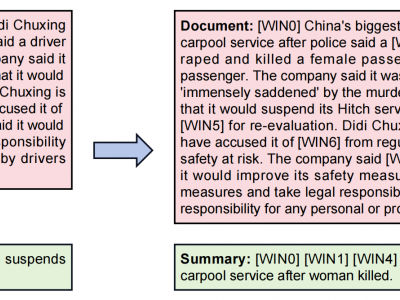
applicability. Preceding studies attribute this problem to the semantic insensitivity of MLE, and they compensate for it with additional unsupervised learning objectives that maximize the metrics of document-summary inferring, however, resulting in unstable and expensive model training. In this paper, we propose a novel supportive windows indexing
grounded summarization (SWIGS) paradigm, where an input document is split into several windows, and a summarization model orderly generates the indices of supportive windows before each summary sentence. Because the supportive windows locate the source information closely related to the summary sentence to be generated, pointing out their indices at first helps to ground the evidence-based summary generation, thus alleviating groundless hallucinations. We create only supervised objectives to learn the SWIGS model and conduct extensive experiments on two well-known datasets to validate its effectiveness. Results vouch for the superiority of SWIGS as it outperforms previous methods regarding multiple metrics.


up
0 users have voted:

Comments

This submission proposes a novel method to reduce hallucinations in abstractive summarization tasks. Overall, the paper is well-written, and the authors conduct extensive experiments on two representative datasets. In the updated version, please provide the results from hybrid and extractive results for comprehensive comparisons following the reviewers’ suggestions and add descriptions about the SOTA methods.