
- Read more about PVD4RCV: A Photo-realistic Multi-Distortion Video Dataset for Benchmarking and Developing Robust Computer Vision Models
- 1 comment
- Log in to post comments
This work addresses a significant gap in existing
image and video databases commonly used in computer vision
applications by introducing a unique and comprehensive
database named Photo-realistic Multi-Distortion Video Dataset
for Benchmarking and Developing Robust Computer Vision
Models (PVD4RCV). A key innovation of PVD4RCV lies in
its incorporation of some relevant physical factors (e.g. depth
information, interaction of light with scene contents) inherent to
video signal acquisition in constrained and complex real-world

- Categories:
 49 Views
This paper presents a framework for accurately tracking objects of complex shapes with joint minimization of geometric and photometric parameters using a coarse 3D object model with the RGB-D cameras. Tracking with coarse 3D model is remarkably useful for industrial applications. A technique is proposed that uses a combination of point-to-plane distance minimization and photometric error minimization to track objects accurately. The concept of 'keyframes' are used in this system of object tracking for minimizing drift.
- Categories:
23 Views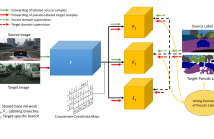
- Read more about A Fully Convolutional Tri-branch Network (FCTN) For Domain Adaptation
- Log in to post comments
A domain adaptation method for urban scene segmentation is proposed in this work. We develop a fully convolutional tri-branch network, where two branches assign pseudo labels to images in the unlabeled target domain while the third branch is trained with supervision based on images in the pseudo-labeled target domain. The re-labeling and re-training processes alternate. With this design, the tri-branch network learns target-specific discriminative representations progressively and, as a result, the cross-domain capability of the segmenter improves.
- Categories:
19 Views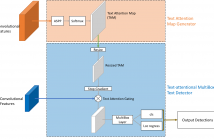
- Read more about Efficient Segmentation-Aided Text Detection for Intelligent Robots_Slides
- Log in to post comments
Scene text detection is a critical prerequisite for many fascinating applications for vision-based intelligent robots. Existing methods detect texts either using the local information only or casting it as a semantic segmentation problem. They tend to produce a large number of false alarms or cannot separate individual words accurately. In this work, we present an elegant segmentation-aided text detection solution that predicts the word-level bounding boxes using an end-to-end trainable deep convolutional neural network.
- Categories:
12 Views- Read more about Efficient Segmentation-Aided Text Detection for Intelligent Robots_Poster
- Log in to post comments
Scene text detection is a critical prerequisite for many fascinating applications for vision-based intelligent robots. Existing methods detect texts either using the local information only or casting it as a semantic segmentation problem. They tend to produce a large number of false alarms or cannot separate individual words accurately. In this work, we present an elegant segmentation-aided text detection solution that predicts the word-level bounding boxes using an end-to-end trainable deep convolutional neural network.
- Categories:
10 Views
- Read more about Discriminant Correlation Analysis for Feature Level Fusion with Application to Multimodal Biometrics
- Log in to post comments
In this paper, we present Discriminant Correlation Analysis (DCA), a feature level fusion technique that incorporates the class associations in correlation analysis of the feature sets. DCA performs an effective feature fusion by maximizing the pair-wise correlations across the two feature sets, and at the same time, eliminating the between-class correlations and restricting the correlations to be within classes.
- Categories:
121 Views